Keweenaw and Late Bronze Age Trade Peer Reviewed Article
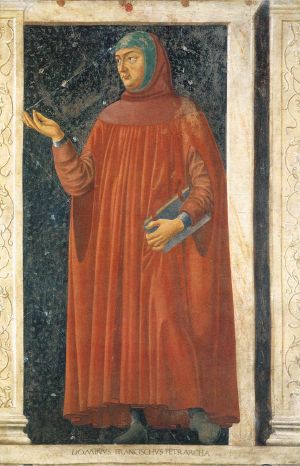
Petrarch, who conceived the idea of a European "Dark Age." From Cycle of Famous Men and Women, Andrea di Bartolo di Bargillac, 1450.
In historiography the phrase the Dark Ages (or Dark Age) is about commonly known in relation to the European Early Eye Ages (from about 476 C.E. to about 1000 C.E.).
This concept of a "Dark Age" was first created by Italian humanists and was originally intended equally a sweeping criticism of the character of Vulgar Latin (Late Latin) literature. Later historians expanded the term to include not only the lack of Latin literature, but a lack of contemporary written history and cloth cultural achievements in general. Popular culture has farther expanded on the term as a vehicle to depict the Center Ages as a time of backwardness, extending its derogatory utilise and expanding its scope. The rise of archaeology and other specialties in the twentieth century has shed much light on the catamenia and offered a more nuanced understanding of its positive developments. Other terms of periodization accept come up to the fore: Late Antiquity, the Early Middle Ages, and the Dandy Migrations, depending on which aspects of civilisation are being emphasized.
Nearly modern historians dismiss the notion that the era was a "Dark Age" by pointing out that this thought was based on ignorance of the period combined with popular stereotypes; many previous authors would but assume that the era was a dismal time of violence and stagnation and utilise this assumption to prove itself.
Contents
- i Petrarch and the "Nighttime Ages"
- 2 The Dark Ages Concept Later on the Renaissance
- 2.1 Reformation
- 2.2 Enlightenment
- 2.3 Romantics
- 3 Modernistic Academic Use
- 4 Modern Popular Apply
- 5 Quotes
- 6 Notes
- 7 References
- 8 External links
- ix Credits
In Britain and the United States, the phrase "Dark Ages" has occasionally been used by professionals, with astringent qualification, equally a term of periodization. This usage is intended equally non-judgmental and but means the relative lack of written record, "silent" as much as "night." On the other paw, this period in Europe did see a retreat from the classical worldview equally political units became smaller and smaller and more competitive. Learning was not highly valued past aristocrats who saw scholarship equally the preserve of the clerical profession. Some classical Greek scholarship was lost to Europe at this time. Knights learned to fight, not to read. Toward the end of this period, some classical Greek sources were rediscovered as part of the legacy that the Arabs had preserved. This encouraged Europeans to once more run across themselves within the context of a larger humanity, with shared aspirations, hopes, and fears. The ideal of a common globe order, known earlier in the European space when it had been more or less united nether Roman dominion, was consequently reborn.
Petrarch and the "Dark Ages"
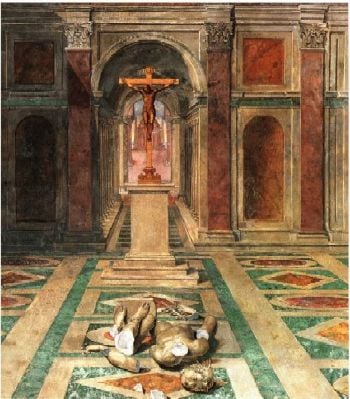
Triumph of Christianity past Tommaso Laureti (1530-1602), ceiling painting in the Sala di Constantino, Vatican Palace. Images like this one celebrate the destruction of ancient pagan culture and the victory of Christianity.
Information technology is by and large accepted that the term "Dark Ages" was invented past Petrarch in the 1330s. Writing of those who had come before him, he said that "amidst the errors at that place shone forth men of genius, no less slap-up were their optics, although they were surrounded by darkness and dense gloom."[i] Christian writers had traditional metaphors of "lite versus darkness" to describe "good versus evil." Petrarch was the first to co-opt the metaphor and give it secular meaning by reversing its application. Classical Antiquity, then long considered the "dark age" for its lack of Christianity, was now seen by Petrarch as the age of "light" considering of its cultural achievements, while Petrarch's fourth dimension, lacking such cultural achievements, was now seen as the age of darkness.
Why did Petrarch call information technology an age of darkness? Petrarch spent much of his time traveling through Europe rediscovering and republishing the classic Latin and Greek texts. He wanted to restore the classical Latin linguistic communication to its onetime purity. Humanists saw the preceding nine hundred year period as a time of stagnation. They saw history unfolding not along the religious outline of St. Augustine's Six Ages of the Earth (from Adam to Noah, from Noah to Abraham, from Abraham to David, from David to the exile of the Hebrews in Babylon, from the return to the time of Jesus, the Christian era) but in cultural (or secular) terms, through the progressive developments of Classical ideals, literature, and fine art.
Petrarch wrote that history had had two periods: the Classic period of the Romans and Greeks, followed by a fourth dimension of darkness, in which he saw himself as withal living. In the conclusion of his epic Africa, he wrote:
My fate is to alive among varied and disruptive storms. Only for you possibly, if every bit I hope and wish y'all will live long later me, in that location will follow a amend historic period. This slumber of forgetfulness volition non last forever. When the darkness has been dispersed, our descendants can come once again in the old pure radiance.[one]
Humanists believed 1 day the Roman Empire would rising again and restore Classic cultural purity. The concept of the European Nighttime Ages thus began every bit an ideological campaign by humanists to promote Classical culture, and was therefore not a neutral historical analysis. It was invented to express disapproval of i period in fourth dimension, and the promotion of some other.
By the late fourteenth and early fifteenth century, humanists such as Leonardo Bruni believed they had attained this new age, and a tertiary, Modern Age had begun. The age before their own, which Petrarch had labeled "Dark," had thus become a "Middle" Age between the Classic and the Modern. The offset apply of the term "Middle Age" appears with Flavio Biondo around 1439.
The Nighttime Ages Concept Afterwards the Renaissance
Historians prior to the twentieth century wrote about the Middle Ages with a mixture of positive and negative (only by and large negative) sentiment.
Reformation
During the Protestant Reformation of the sixteenth century, Protestants wrote of it as a menstruum of Catholic corruption. Just every bit Petrarch's writing was not an attack on Christianity per se—in improver to his humanism he was deeply occupied with the search for God—neither of course was this an attack on Christianity, but the opposite: a drive to restore what Protestants saw as a "purer" Christianity. In response to these attacks Roman Catholic reformers developed a counter prototype, depicting the historic period every bit a flow of social and religious harmony, and non "dark" at all.
Enlightenment
During the seventeenth and eighteenth century, in the Age of Enlightenment, religion was seen every bit antithetical to reason. Because the Middle Historic period was an "Age of Religion" when religion reigned, it was seen as a catamenia contrary to reason, and thus contrary to the Enlightenment. Immanuel Kant and Voltaire were 2 Enlightenment writers who were vocal in attacking the religiously dominated Middle Ages equally a period of social refuse. Many modernistic negative conceptions of the age come from Enlightenment authors.
Yet but equally Petrarch, seeing himself on the threshold of a "new age," was criticizing the centuries upwards until his own time, so too were the Enlightenment writers criticizing the centuries upwardly until theirs. These extended well after Petrarch'southward fourth dimension, since religious domination and conflict were still common into the seventeenth century and fifty-fifty across, albeit diminished in telescopic.
Consequently an evolution had occurred in at least three ways. Petrarch'south original metaphor of "light versus dark" had been expanded in time, implicitly at to the lowest degree. Even if the early on humanists subsequently him no longer saw themselves as living in a "nighttime" age, their times were still not "low-cal" plenty for eighteenth century writers who saw themselves every bit living in the real "historic period of Enlightenment," while the period covered by their own condemnation had extended and was focused also on what we now call Early Modern times. Additionally, Petrarch'due south metaphor of "darkness," which he used mainly to deplore what he saw every bit a lack of secular achievements, was now sharpened to accept on a more explicitly anti-religious pregnant in low-cal of the callous tactics of the Cosmic clergy.
In spite of this, the term "Middle" Ages, used past Biondo and other early on humanists after Petrarch, was the proper name in full general use earlier the eighteenth century to announce the period up until the Renaissance. The earliest recorded use of the English word "medieval" was in 1827. The term "Dark Ages" was also in utilize, but by the eighteenth century information technology tended to exist confined to the earlier function of this "medieval" menstruum. Starting and ending dates varied: the "Dark Ages" were considered by some to start in 410, by others in 476 when there was no longer an emperor in Rome itself, and to end about 800 at the time of the Carolingian Renaissance under Charlemagne, or to extend through the residue of the beginning millennium up until about the year 1000.
Romantics
In the early nineteenth century, the Romantics reversed the negative assessment of Enlightenment critics. The give-and-take "Gothic" had been a term of opprobrium akin to "Vandal," until a few cocky-confident mid-eighteenth century English language "goths" similar Horace Walpole initiated the Gothic Revival in the arts, which for the following Romantic generation began to take on an idyllic image of the "Age of Faith." This epitome, in reaction to a world dominated by Enlightenment rationalism in which reason trumped emotion, expressed a romantic view of a Aureate Age of chivalry. The Eye Ages were seen with romantic nostalgia as a flow of social and environmental harmony and spiritual inspiration, in contrast to the excesses of the French Revolution and the ecology and social upheavals and sterile utilitarianism of the emerging industrial revolution. The Romantics' view of these before centuries can still be seen in modern-solar day fairs and festivals celebrating the period with costumes and events.
Just as Petrarch had turned the pregnant of "light versus darkness" on its head, and then had the Romantics turned the judgment of Enlightenment critics. However, the period idealized by the Romantics focused largely on what is now called the High Centre Ages, extending into Early on Modern times. In one respect this was a reversal of the religious attribute of Petrarch'south judgment, since these later centuries were those when the universal power and prestige of the Church building was at its superlative. To many users of the term, the scope of the "Dark Ages" was becoming divorced from this period, now denoting mainly the earlier centuries afterward the autumn of Rome.
Modern Bookish Use
When modern scholarly study of the Middle Ages arose in the nineteenth century, the term "Night Ages" was at first kept with all its critical overtones. Although it was never the more formal term (universities named their departments "medieval history," non "nighttime age history"), information technology was widely used, including in such classics as Gibbon's The History of the Decline and Fall of the Roman Empire, where information technology expressed the author's contempt for "priest-ridden," superstitious, nighttime times. However the early twentieth century saw a radical re-evaluation of the Middle Ages, and with it a calling into question of the terminology of darkness. The historian Denys Hay spoke ironically of "the lively centuries which we phone call night."[2] It became clear that serious scholars would either take to redefine the term or abandon information technology.
When the term "Night Ages" is used past historians today, it is intended to be neutral, namely to express the idea that the events of the period often seem "nighttime" to u.s., due to the lack of historical records compared with later times. The darkness is ours, not theirs. Yet, since in that location is no shortage of information on the Loftier and Late Centre Ages, this required a narrowing of the reference to the Early Heart Ages. Belatedly fifth and sixth century Britain for example, at the height of the Saxon invasions, might well be numbered among "the darkest of the Dark Ages," with the equivalent of a near-full news blackout compared with either the Roman era before or the centuries that followed. Further due east the same was true in the formerly Roman province of Dacia, where history after the Roman withdrawal went unrecorded for centuries as Slavs, Avars, Bulgars, and others struggled for supremacy in the Danube basin; events there are still disputed. Withal, at this time the Byzantine Empire and the Abbasid Caliphate experienced ages that were golden rather than dark; consequently, this usage of the term must also differentiate geographically. Ironically, while Petrarch's concept of a "Nighttime Age" corresponded to a mostly "Christian" period following infidel Rome, the neutral utilise of the term today applies mainly to those cultures to the lowest degree Christianized, and thus most sparsely covered by the Church's historians.
However, from the mid-twentieth century onward an increasing number of scholars began to critique fifty-fifty this non-judgmental use of the term. There are two primary criticisms. Firstly, it is questionable whether it is possible to utilise the term "night ages" finer in a neutral way; scholars may intend it that way, but this does not mean that ordinary readers volition understand it so. Secondly, the explosion of new knowledge and insight into the history and culture of the Early Middle Ages which twentieth century scholarship has achieved means that these centuries are no longer night even in the sense of "unknown to us." Consequently, many bookish writers prefer non to use the phrase at all.
Modern Popular Utilise
In mod times, the term "Nighttime Ages" is still used in pop civilization. Petrarch's ideological campaign to pigment the Heart Ages in a negative light worked and so well that "Nighttime Ages" is still in popular use nearly seven hundred years subsequently. The humanists' goal of reviving and revering the classics of antiquity was institutionalized in the newly forming universities at the time, and the schools over the centuries have remained truthful to their humanist roots. Students of instruction systems today are familiar with the canon of Greek authors, but few are e'er exposed to the great thinkers of the Middle Ages such as Peter Abelard or Sigerus of Brabant. While the classics programs remain strong, students of the Middle Ages are not nearly as common. For instance the first medieval historian in the United States, Charles Haskins, was not recognized until the early twentieth century, and the number of students of the Middle Ages remains to this twenty-four hour period very small compared to the classics.
Historians today believe that the negative connotations of the give-and-take "dark" in "Dark Ages" negates its usefulness as a description of history. Even so Petrarch's concept of it, similar that of other early humanists later him, as a detached menstruum distinct from our "Mod" age, has endured, and the term nonetheless finds employ, through various definitions, both in popular culture and academic soapbox.
Quotes
- "What else, then, is all history, simply the praise of Rome?"—Petrarch
- "Each famous writer of artifact whom I recover places a new offence and some other cause of dishonour to the accuse of earlier generations, who, non satisfied with their own disgraceful barrenness, permitted the fruit of other minds, and the writings that their ancestors had produced by toil and awarding, to perish through insufferable fail. Although they had nothing of their own to paw down to those who were to come after, they robbed posterity of its ancestral heritage."—Petrarch
- "The Middle Ages is an unfortunate term. Information technology was not invented until the age was long past. The dwellers in the Middle Ages would not take recognized it. They did not know that they were living in the middle; they thought, quite rightly, that they were time's latest achievement."—Morris Bishop[three]
Notes
- ↑ 1.0 1.i Theodore Due east. Mommsen, Petrarch's Conception of the 'Dark Ages' Speculum 17(two) (April, 1942): 226-242. Retrieved January x, 2022.
- ↑ Denys Hay, Annalists and Historians (Methuen & Co. Ltd, 1977, ISBN 978-0416811803), 50.
- ↑ Morris Bishop, The Middle Ages (Mariner Books, 2001, ISBN 978-0618057030), vii.
References
ISBN links support NWE through referral fees
- Bishop, Morris. The Center Ages. Mariner Books, 2001 (original 1968). ISBN 978-0618057030
- Black, Winston. The Eye Ages: Facts and Fictions. ABC-CLIO, 2019. ISBN 978-1440862311
- Hay, Denys. Annalists and Historians. Methuen & Co. Ltd, 1977. ISBN 978-0416811803
- Mommsen, Theodore Eastward. Petrarch's Formulation of the 'Dark Ages' Speculum 17(2) (Apr, 1942): 226-242. Retrieved January x, 2022.
- Sultanate of oman, Charles. The Nighttime Ages 476-918 C.E. Independently published, 2017 (original, 1893). ISBN 1973427370
External links
All links retrieved January 10, 2022.
- Why the Middle Ages are chosen the Dark Ages Medievalists.
- half-dozen Reasons the Night Ages Weren't So Dark History.com.
- Why It'south Time to Shed Some Light on History's 'Dark Ages' TIME
Credits
New Globe Encyclopedia writers and editors rewrote and completed the Wikipedia article in accord with New Globe Encyclopedia standards. This article abides by terms of the Creative Commons CC-by-sa 3.0 License (CC-by-sa), which may be used and disseminated with proper attribution. Credit is due under the terms of this license that can reference both the New Earth Encyclopedia contributors and the selfless volunteer contributors of the Wikimedia Foundation. To cite this article click here for a list of acceptable citing formats.The history of earlier contributions by wikipedians is accessible to researchers here:
- Dark Ages history
The history of this article since it was imported to New World Encyclopedia:
- History of "Dark Ages"
Note: Some restrictions may apply to use of private images which are separately licensed.
Source: https://www.newworldencyclopedia.org/entry/Dark_Ages
0 Response to "Keweenaw and Late Bronze Age Trade Peer Reviewed Article"
Post a Comment